Deal Connections or Real Connections? Why a Strong Network Needs Both
Most successful professionals accumulate a large network throughout their careers.
Former colleagues. Clients. Business partners. Vendors. Investors. Advisors. Industry peers. People met at conferences, on boards, through LinkedIn, or during a project years ago.
But not every connection plays the same role in our professional lives.
There are deal connections and there are real connections.
Both matter. Both can create tremendous value throughout a career. And calling one a “real connection” doesn’t mean a deal connection isn’t genuine or valuable. It simply describes a relationship that has developed beyond the business opportunity or professional interest that originally brought two people together.
Understanding the difference can help us better appreciate—and build—the networks around us.
One question can reveal that difference surprisingly quickly:
If there were no business opportunity between us for the next five years, would we still have a relationship?
There isn’t a right or wrong answer. But the answer tells us something important about the nature of the connection.
What Is a Deal Connection?
A deal connection is a professional relationship built primarily around a shared business purpose.
Someone needs to hire. Someone wants to sell. Someone is considering a career move. A company needs financing. An executive needs advice. Two organizations see an opportunity to work together.
These connections are an essential part of business.
They introduce us to people outside our immediate circles. They expose us to new ideas and information. They generate opportunities, introductions, partnerships, referrals and sometimes entirely new directions in our careers or businesses.
And they don’t have to become something deeper to be valuable.
A former client you speak with occasionally may introduce you to your next customer. An executive you met once at a conference may share an important market insight. A former candidate may call years later about an opportunity. An industry contact may connect you with someone you otherwise never would have met.
These relationships create reach.
And reach matters.
What Makes a Connection a Real Connection?
Some professional relationships develop differently.
The initial reason for meeting may have been business, but over time the relationship becomes about more than the transaction that introduced the two people.
There is trust. Mutual respect. Genuine interest. Shared experiences. A willingness to help without always calculating the immediate return.
You know more about the person than what appears on their LinkedIn profile.
You understand something about their ambitions, challenges, family, interests or experiences.
You might send an article because it made you think of them. Make an introduction without asking for anything in return. Congratulate them on a promotion. Call after they lose a job. Share information that could help their business even when there is nothing in it for you.
Most importantly, the relationship can continue when there isn’t a transaction attached to it.
Harvard Business Review has described strong professional relationships as involving factors such as trust, diversity of perspective and mutual engagement—not simply what two people can do for one another at a particular moment.
These relationships create depth.
And depth matters, too.
Not Every Connection Needs to Become a Real Connection
This distinction is important.
The goal shouldn’t be to turn every professional acquaintance into a close relationship.
That’s neither realistic nor necessary.
Sociologist Mark Granovetter demonstrated this decades ago through his influential research on the “strength of weak ties.” People outside our closest circles can be particularly valuable because they expose us to information, people and opportunities we might not otherwise encounter.
More recent research has continued to demonstrate the importance of these weaker professional connections, including their role in career mobility and access to new opportunities.
In other words, the people we know less deeply can sometimes introduce us to possibilities that the people closest to us cannot.
That leads to an important distinction:
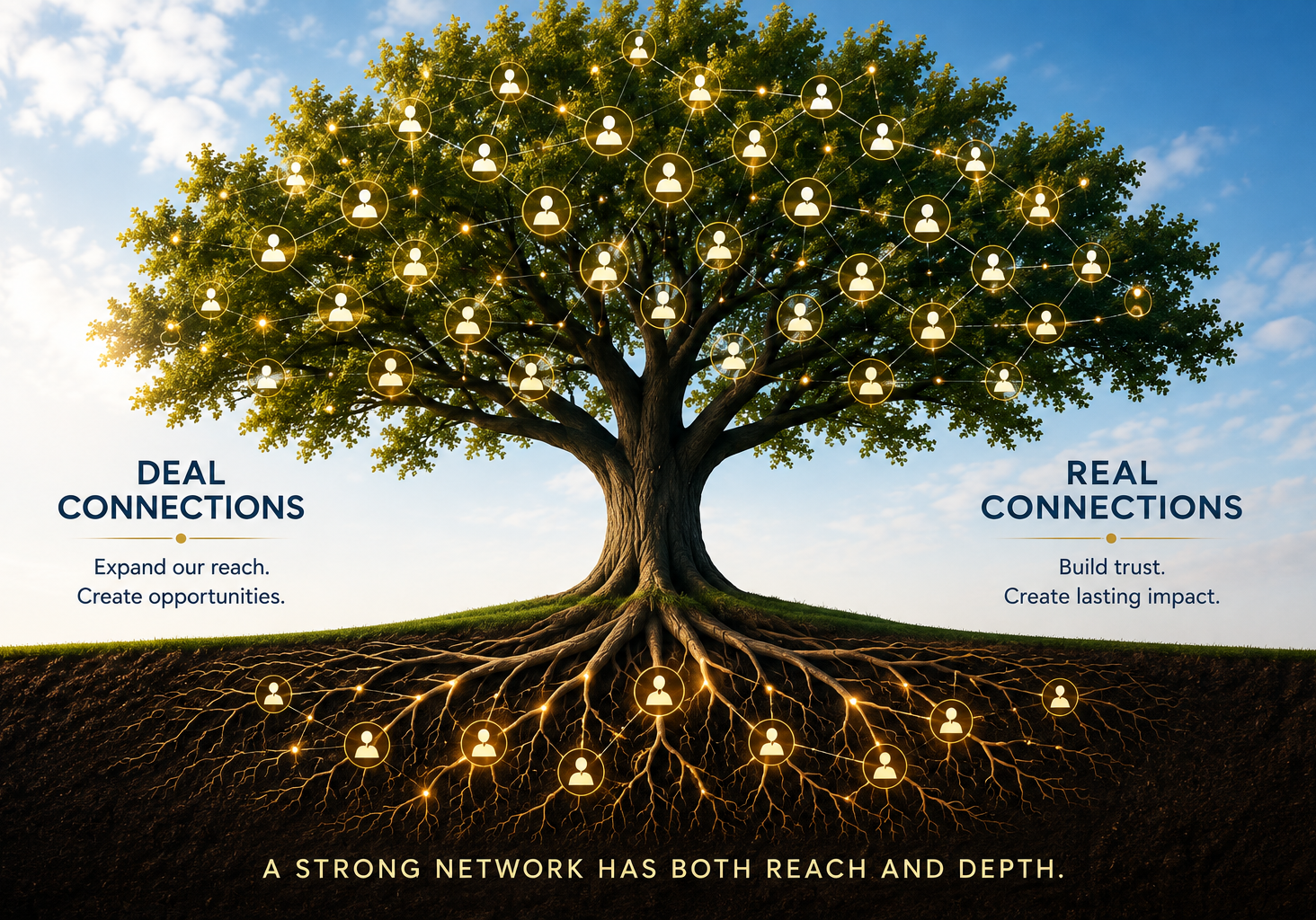
A wide network creates reach. A deep network creates trust.
A valuable professional network needs both.
When a Deal Connection Becomes Something More
Most real professional relationships probably didn’t begin as real relationships.
They started somewhere.
A recruiter called an executive about an opportunity.
A salesperson contacted a prospective customer.
Two leaders met while serving on a board.
An investor met a founder.
A consultant began working with a CEO.
Initially, the relationship may have been almost entirely transactional.
That’s okay.
The opportunity introduces the people. What they do afterward determines whether the relationship becomes something more.
Sometimes it doesn’t. The two people remain useful professional contacts for years, and there can be tremendous value in that.
Other times, something changes.
They remain interested after the immediate need disappears.
They continue exchanging ideas.
They make introductions.
They help each other.
They stay connected when someone changes companies.
Eventually, neither person needs a reason to call the other.
A relationship that began because of a deal has developed beyond the deal.
Real Connections Are Built Between the Deals
It’s easy to maintain a relationship when there is an obvious reason to communicate.
There’s a search underway. A potential sale. A project. An investment. A partnership opportunity.
The more revealing moments often happen between those opportunities.
Do you stay connected when there is nothing on the table?
Do you occasionally share something useful?
Do you make an introduction simply because two people should know each other?
Do you congratulate someone when something good happens?
Do you check in when something difficult happens?
Do you remain curious about where their career or business is heading?
Real connections are rarely created through one significant gesture.
They’re usually built through dozens of small interactions over many years.
Trust Compounds
There is an interesting paradox in business relationships.
If every relationship is evaluated solely by its immediate business potential, we may miss much of its long-term value.
Someone you helped five years ago becomes a CEO.
A candidate becomes a client.
A client moves to another organization and calls again.
A former colleague makes an introduction.
Someone remembers an act of generosity long after you’ve forgotten it.
An acquaintance becomes a trusted friend.
None of those outcomes may have been visible when the relationship began.
That’s relationship compounding.
And in a business environment increasingly filled with automated outreach, digital interactions and AI-generated information, trusted human relationships may become even more valuable.
Technology can dramatically expand our ability to connect.
It cannot automatically create connection.
What Kind of Network Are You Building?
A successful career can produce thousands of professional contacts.
Some will introduce us to ideas, information and opportunities.
Some will help us accomplish important business objectives.
Some will remain occasional but valuable professional acquaintances.
And a smaller number will become relationships that survive job changes, company changes, successes, disappointments—and long periods when neither person needs anything from the other.
We need all of them.
The strength of a professional network isn’t determined simply by how many people we know. And it isn’t determined solely by how many deep relationships we have.
A strong network has both reach and depth.
Deal connections help create the reach.
Real connections create the depth.
So look across your own network and consider the people you’ve met throughout your career.
Then ask yourself:
If there were no business opportunity between us for the next five years, would we still have a relationship?
There is no wrong answer.
But knowing the answer helps us better understand the relationships we’ve built—and reminds us that some of the most meaningful professional relationships may have started with nothing more than a deal.
Artemis Consultants recruits exceptional Mid to C-Level talent for emerging and established companies. We exist for two reasons: to help organizations grow by recruiting highly qualified leaders and professionals, and to help talented people discover career opportunities that positively impact their lives.
People. Performance. Possibilities.
Delivering Talent Worth the Hunt.